Why Your AI Content Sounds Like Everyone Else's
AI help makes each draft rate better on its own while the whole set grows more alike, so review AI-assisted content side by side with competitors' work.
The draft in front of you is probably better for the AI help. It reads more smoothly and covers more ground, and strangers asked to rate it would likely score it above the version you would have written alone. What no rating of a single draft can tell you is how closely it resembles every other draft on the same subject, because resemblance only shows up when you look at several at once.
So a review that looks at one draft at a time grades the polish AI is good at adding and misses the variety it tends to take away. Researchers have now caught both effects in the same data. The obvious response, a fresh visual style, is easy for the same tools to imitate. The more durable fix is to change what sits beside the draft when someone decides whether it ships.
Scored one at a time, the AI-assisted ideas won
In experiments published in Nature Human Behaviour in 2024, people came up with ideas such as gift suggestions and toys built from everyday objects, some with ChatGPT's help and some with a web search or nothing at all. Each participant submitted one idea, outside judges rated each one, and the ChatGPT-assisted ideas came out more creative on average (Nature Human Behaviour).
Three Wharton researchers then went back to the same data and asked how much the ideas differed from one another. In 37 of 45 comparisons, the ChatGPT-assisted set was significantly less varied. On the toy task, 94 percent of the ChatGPT-assisted ideas shared overlapping concepts, and nine participants independently named their toy "Build-a-Breeze Castle" (Wharton's Mack Institute). The ideas were identical in both analyses; the verdict changed because someone compared them.
A separate experiment with short stories found the same split. Writers who could draw on AI-generated story ideas produced stories that readers, shown one at a time, rated as more creative and better written, and the least creative writers gained the most. Compared with each other, though, those stories were more alike than the ones people wrote unaided. The authors describe it as a social dilemma: each writer comes out ahead, and the group produces a narrower range of work (Doshi and Hauser).
We made a similar argument about automation in September: approving AI outputs one by one cannot catch a system whose behavior has quietly changed, because the change only shows up across many outputs. Creative sameness has the same property. Reviewers who miss it are not being careless; a single draft simply contains no trace of it.
The same tools can copy a new look
If sameness is the problem, changing how the work looks is the obvious response, and r/PPC got a preview of how that goes last week. A thread titled "Tired of AI creatives, time to go analog" held up a crude, hand-drawn-looking Facebook ad for a local roofer as a break from polished AI work. The first reply said some of these posters were AI-made, and others agreed: one pointed to lettering too precise for a real hand, another to the gap between the stick-figure roofer and a perfectly drawn car. A third had seen the look spreading already: "The bots are already generating fake hand-drawn posters in the same style" (r/PPC).
That commenter took the copying as proof the style works, and it may well work. It also shows why a look cannot keep you distinct: once a tool can produce it on demand, your competitors can have it too.
Kieran Flanagan, who co-hosts the Marketing Against the Grain YouTube channel and was by his own account an early adopter of AI for content, has reached a similar conclusion about ideas. He no longer lets AI generate his ideas or write his drafts, and he says the AI-sourced ideas he did use underperformed the ones that came from his own head. His explanation: "AI drags you to the center" (Kieran Flanagan).
Where he kept AI is just as telling. On long-form posts, AI sees his work only after he has written it, through an editing prompt that may suggest at most five changes ranked by impact and must never rewrite the post. The prompt closes with a test: "If the only benefit is that the writing sounds more polished, don't suggest it." That is the kind of improvement a one-at-a-time review rewards, and he has ruled it out.
Review the draft beside the competition
A single draft carries no evidence of sameness, so the review has to bring the evidence in. Before anyone opens your draft, collect three to five recent pieces your competitors have published on the same subject, such as the pages that rank for the query you are targeting or the ads they run at the audience you want, and put them in the same document. Then run a swap test: strip the logos and names from everything and ask someone outside the team to pick out yours.
Key Insight
If nobody can tell which piece is yours, the draft fails, however well it reads, because the polish that makes it read well is available to every competitor using the same tools.
Score the claim separately from the craft. Write one sentence stating what your draft says that the comparison pieces do not. A reply in an r/DigitalMarketing thread on which skills survive AI explains why that sentence is hard to get from a model: "AI can summarize what's already been written down, but it can't go get the insight nobody has recorded yet." The same reply lists where such insight comes from, including talking to buyers, sitting in on sales calls and reading support tickets (r/DigitalMarketing).
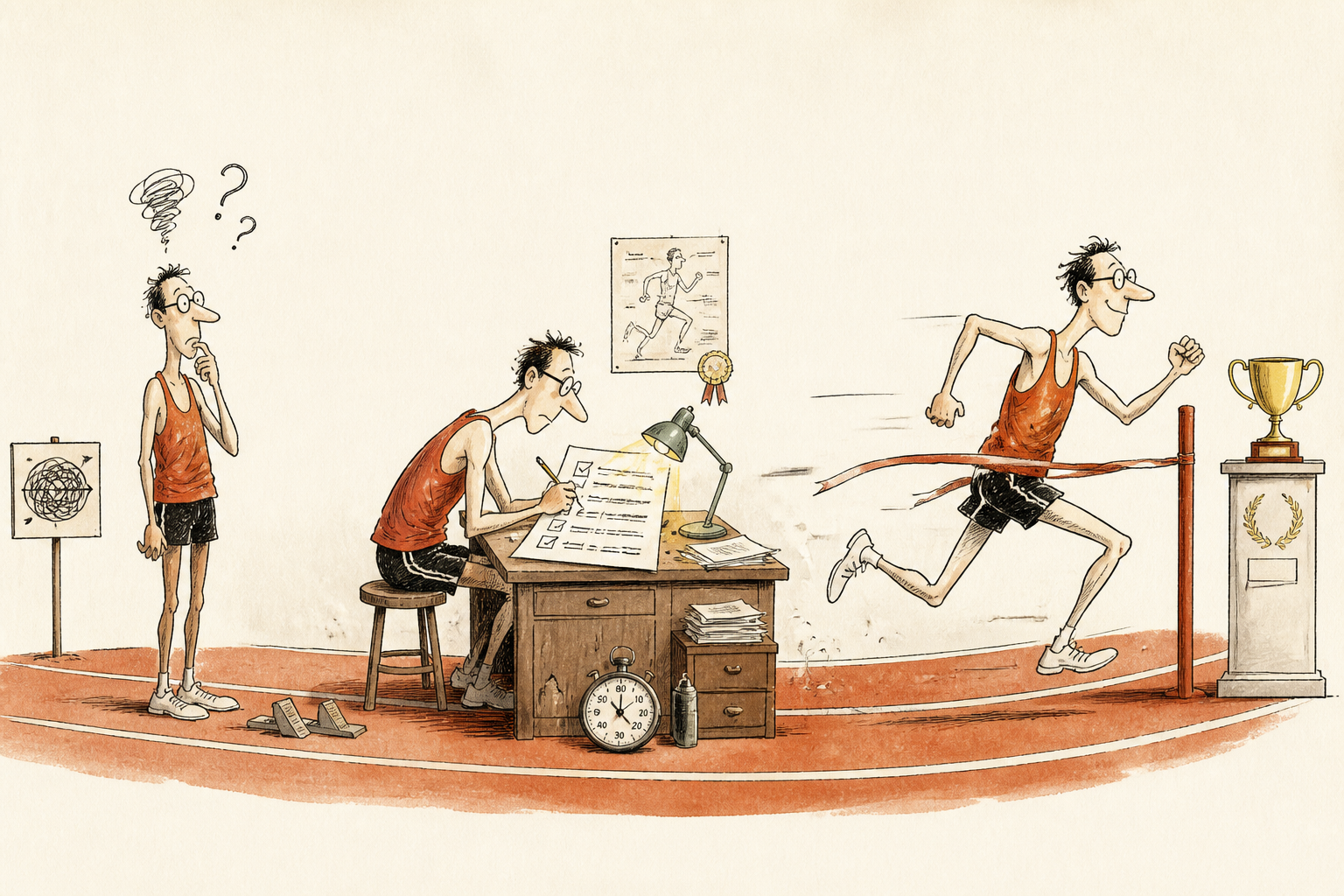
The cheapest way to pass is to settle that sentence before the AI sees the brief. If your team needs a habit for it, start with a four-question worksheet for pinning down what a piece must do, and what failure looks like, before you open an AI tool. After that, AI can do the job Flanagan gives it, which is pointing out structural problems in a draft that already says something.
Where the evidence runs out
None of this means AI-assisted work loses when it is tested, and the strongest counter-evidence deserves a hearing. Researchers at the Technical University of Munich and TU Berlin ran a field test in which an AI-generated banner ad earned a 50 percent higher click-through rate than a professionally made stock photo (TUM School of Management). That result is real, and it comes from the setting where AI does best, a single ad tested on its own merits. A head-to-head test compares your ad with your other ad; it cannot show how your ad sits among everyone else's once your competitors use the same tools.
The lab evidence has limits too. The stories were eight sentences long, and the ideas were things like gifts and toys. Nobody has yet measured what category-wide sameness does to campaign results. Doshi and Hauser describe a spiral in which better individual scores encourage more AI use and the shared pool of work narrows further, which suggests the cost builds as adoption spreads rather than arriving all at once.
Some work should look like everyone else's. A returns policy or a help article succeeds by being predictable, and a swap test there would punish the right answer. Save the comparison for pieces whose job is to be remembered, like a campaign or an ad meant to stop someone scrolling. For those, the review document should open with three competitor pieces before it gets to yours.
Sources
- ChatGPT decreases idea diversity in brainstorming, Lennart Meincke, Gideon Nave and Christian Terwiesch, Nature Human Behaviour, May 2025
- New in Nature: ChatGPT Decreases Idea Diversity in Brainstorming, Mack Institute for Innovation Management, Wharton, May 2025
- Generative AI enhances individual creativity but reduces the collective diversity of novel content, Anil R. Doshi and Oliver P. Hauser, Science Advances, July 2024
- Tired of AI creatives, time to go analog, r/PPC, 30 October 2026
- Stop using AI for writing, Kieran Flanagan, 30 October 2026
- Which marketing skills will still matter when AI can run most campaigns?, r/DigitalMarketing, 27 October 2026
- The Power of Generative AI in Visual Marketing, TUM School of Management, November 2024
Go deeper
Promptafire lesson
Think Before You Prompt
The meta-skill underneath all prompt engineering: structured thinking before AI contact.
Keep reading
September 8, 2026
Your AI Visibility Number Is Not Comparable to Anyone Else's
AI visibility tools report figures more than four times apart on the same metric, so treat your own citation data as a trend in one tool, not a benchmark.
August 24, 2026
SEO and AI Visibility Are Drifting Apart. Measure Them Separately.
A market correlation makes SEO and AI-answer visibility look like they are converging, but individual sites diverge, so measure the two separately.
November 24, 2026
Reddit Monitoring Loses the Access ChatGPT and Google Keep
Reddit's RSS and API shutdown cuts off brand monitoring tools but not the AI engines that license its threads, so watch the few threads that rank in Google.